








Open menu Menu closed
 | Bamboom

newborn Always in Your Arms: A Habit or a Need?
What Neuromotor Development Tells Us About the Use of Supports Like Baby Slings and Baby Carriers

“If you always hold him in your arms, he’ll get used to it.”
This is something many new parents hear over and over again. Yet, in the first few months, seeking adult contact is not a bad habit:it’s a physiological need of the newborn.
Being held, feeling the parent’s warmth, voice, scent, and movement can help the baby feel safe and gradually regulate his own emotional states.
Furthermore, from the perspective of neuromotor development, physicalcontact and autonomy are not conflicting needs: they can go hand in hand.

 | Bamboom

Does being held in someone's arms hinder motor development?

No. We can meet the “ Child ’s” need for closeness and, at the same time, support their motor development.
Being carried allows the “ Child ” to perceive the adult’s movements, experience constant changes in position, and receive a wealth of sensory information. Even when in a wrap or baby carrier, their body is challenged to adapt to the movements of the person carrying them, gradually contributing to the development of postural control.

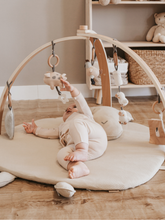
This experience goes hand in hand with free movement: throughout the day, it’s important to also give the Child opportunities to explore their own body independently on the mat—on their back, on their stomach during Tummy Time, and, as they grow, in the various positions they’ll gradually be able to achieve. These are different yet complementary experiences. The key word isvariety.

Baby sling or baby carrier?

Both allow you to carry your Child close to your body, but they have different features.
Thewrapis a soft, snug, and highly adaptable carrier that conforms to the body Child. This is precisely why it is particularly suitable during the first few months, when postural control is still developing.
Thebaby carrier, on the other hand, is a more structured carrier. Today, there are ergonomic and adjustable models that can also be used in the first few months, provided they are truly suited to the size of the Child and adjusted correctly.

In both cases, a simple principle applies:the carrier must adapt to the Child, not the Child to the carrier.

The thighs should be adequately supported, and the hips should be free to remain flexed and spread apart, with the knees generally higher than the buttocks, without forcing a predetermined position.


 | Bamboom

 What about the rest of the world?

I don’t usually recommend the “facing out” position in a wrap or baby carrier, especially during the first few months.

One of the most valuable aspects of babywearing is precisely thebelly-to-belly and heart-to-heart contact: the Child feels the adult’s body and can observe their surroundings while keeping the parent as a point of reference—almost like a filter through which to learn about the world.

There is also a postural aspect. In the first few months, the newborn ’s spine still has a physiological overall kyphotic curvature, and control of the head and trunk is still developing. When facing forward, however, the body tends to assume a more upright and less hunched position.

This does not mean that the Child cannot look at what is happening in front of him:we can offer him the forward-facing position in our arms, where we can continuously adjust his position, support him according to his abilities, and bring him back toward us when he feels the need.

 | Bamboom

Yes, wear a mask—but don't forget about freedom of movement

Baby slings and carriers can therefore be invaluable allies in everyday life and provide a unique experience for the Child, but they should be part of a day filled with a variety of different opportunities.

The Child needs physical contact, but also space to move their arms and legs freely, experience “Tummy Time,” reach for an object, and—as they grow—roll over and move around.

There’s no need, therefore, to choose betweenkeeping them close and guiding them toward independence. In the first few months, independence doesn’t come from separating the Child from adults too early, but rather from offering them security and, gradually, ever-new opportunities to explore their own bodies.

A Note on Safety

Whichever carrier is chosen, it must be appropriate for the child’s age, size, and developmental abilities Child and used according to the manufacturer’s instructions.

In the newborn , the face must always be visible and the airways clear: the nose and mouth must not be covered, and the chin must not be forced against the chest.

Arms, slings, baby carriers, and mats are therefore not alternatives to choose from, but rather different and complementary experiences that accompany the Child in discovering their own body and the world around them.

By Dr. Francesca Rocchi

Francesca Rocchi is a pediatric physical therapist who specialized in psychomotor and musculoskeletal development in children at the Meyer Children’s Hospital in Florence.

She works in Parma with infants, children, and adolescents, focusing on the assessment and treatment of motor and postural development, developmental challenges, and musculoskeletal issues.

She also supports parents by providing practical guidance on daily care, motor experiences, and the use of infant and child equipment. She conducts training and outreach activities on topics related to pediatric physical therapy and psychomotor development.